
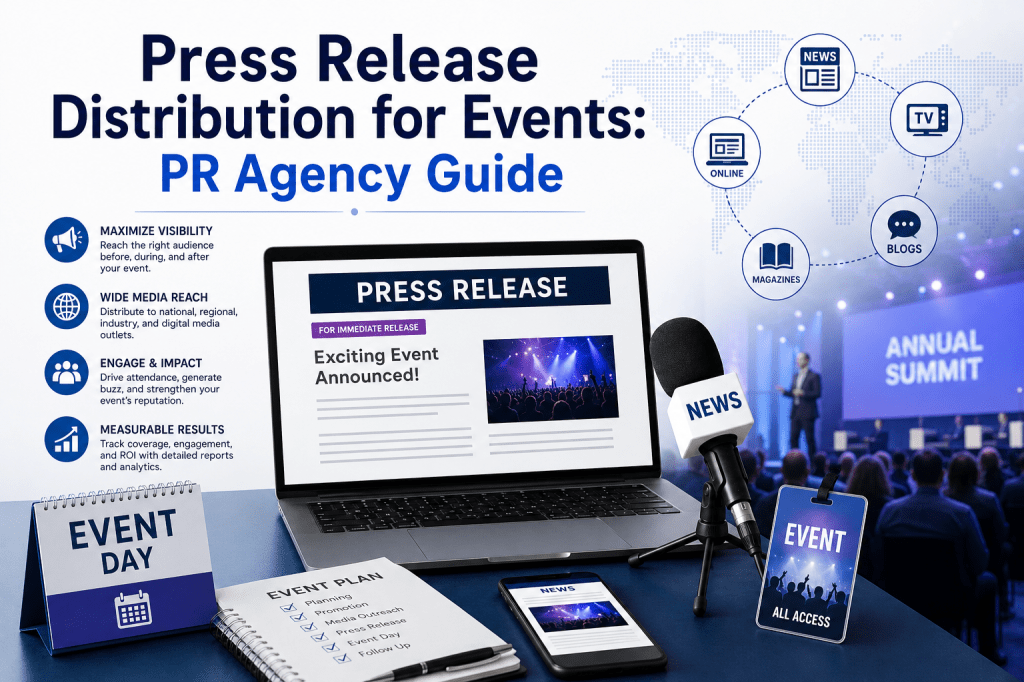
Press release distribution for events is the process of writing, publishing, and promoting an event announcement through media outlets, journalists, newswires, search engines, and digital platforms. A PR agency helps event organizers turn one announcement into broader visibility, stronger trust, better attendance, and lasting online authority.
For general readers, the idea is simple: an event press release tells the public why an event matters, who should attend, when it happens, where it takes place, and how people can participate. However, strong distribution makes the difference between a release that disappears and a release that earns attention.
Recent media research supports this approach. Cision’s 2025 State of the Media report says 72% of journalists still cite press releases as the most useful resource PR teams can offer, while 86% reject pitches that are not relevant to their beat or audience.
Quick answer: Press release distribution for events works best when the announcement is newsworthy, timely, targeted, and supported by clear facts. APR agency can improve results by writing the release, choosing the right channels, pitching relevant media, and tracking performance after publication.
Event promotion is also becoming more important because live experiences remain powerful marketing channels. Cvent’s 2026 event statistics roundup reports that 72% of marketers say events are the most effective marketing channel for their organizations.
Why a PR agency matters for event press release distribution today in local markets
A PR agency matters because event promotion requires more than sending one announcement online. The agency helps shape the story, define the audience, select media targets, and align the release with registration goals. This is especially useful for conferences, charity events, product launches, trade shows, festivals, and business networking events.
A professional agency also understands timing. For example, a public event may need awareness weeks before attendance closes, while a corporate event may need post-event coverage for reputation building. Therefore, the distribution plan should match the event purpose.
A strong public relations agency also protects credibility. It helps avoid exaggerated claims, weak headlines, missing details, and unclear calls to action. As a result, journalists and readers can understand the announcement faster.
Define event news value before selecting any public relations agency partner online
Event news value is the reason an event deserves public attention. It may come from a respected speaker, a major brand partnership, a local community benefit, a new product reveal, a fundraising goal, or an industry trend. Without clear news value, even paid distribution may not create meaningful visibility.
Before choosing any partner, event teams should define the core angle in one sentence. For example, “This event connects local startups with investors” is stronger than “We are hosting a business event.” The first version explains who benefits and why the event matters.
A goodonline PR agency will ask about audience, location, event format, speaker authority, timing, and measurable goals before writing the release.
Create a media kit journalists can use without extra clarification during deadlines
A media kit is a collection of ready-to-use event assets. It should include the press release, event logo, speaker photos, organizer bio, venue details, registration link, media contact, fact sheet, and approved quotes. This saves journalists time and reduces errors.
The best media kits are clear, lightweight, and easy to access. Use labeled folders and simple file names. Include high-resolution images and short captions. Also, add event dates, city names, and official social media handles. When a reporter has everything in one place, coverage becomes easier.
How press release wire coverage helps events reach journalists and audiences faster
A press release wire distributes an event announcement to media databases, online news platforms, search engines, and sometimes industry-specific channels. It helps event organizers move beyond owned media, such as their website or social pages. Therefore, wire distribution can support visibility when the event needs wider discovery.
The key difference between direct pitching and wire distribution is scale. Direct pitching targets selected journalists personally, while a wire can publish and circulate the release across broader networks. The best strategy often uses both.
A press release wire is useful when an event has public relevance, commercial importance, regional value, or industry interest. However, wire distribution should not replace good writing. A weak release distributed widely is still a weak release.
Match local city coverage with national and global newswire distribution goals carefully
Local coverage works well for community events, city conferences, university programs, charity drives, exhibitions, and regional business announcements. National coverage works better when the event involves recognized brands, major speakers, industry data, investor interest, or multi-city participation. Global distribution fits international summits, financial events, technology launches, and cross-border business announcements.
Event teams should match the distribution level with the expected audience. A local food festival may not need global distribution, but a fintech conference with international speakers may benefit from wider reach. This prevents budget waste.
A global newswire distribution plan should include location signals, topic keywords, spokesperson quotes, and a clear event registration path.
Segment outreach by geography industry beat and event audience type carefully first
Segmentation means dividing media targets by relevance. An event about healthcare technology should not be pitched to entertainment reporters. A music festival should not be pitched like a finance summit. Relevance improves response rates and protects the organizer’s reputation.
Useful segments include local news, trade media, business media, lifestyle media, community calendars, industry newsletters, podcasts, and influencer outlets. Each segment needs a slightly different pitch angle. For example, local media may care about community impact, while trade media may care about industry innovation.
When PR wire services should announce conferences launches festivals and community events
PR wire services should be used when the event announcement has enough public value to justify broader distribution. This may include a new conference, public festival, award ceremony, trade show, charity fundraiser, product launch, executive summit, sports event, or major partnership announcement.
Timing is important. Most event announcements should go out early enough for readers to plan attendance. However, a second release may be useful after the event to share outcomes, attendance numbers, awards, partnerships, or major quotes.
Professional PR wire services help organizers choose the right release type. Pre-event releases drive awareness and registrations. Same-week media alerts support attendance. Post-event releases build credibility and search visibility. Each format has a different purpose.
Build a timeline around registration deadlines speaker news and media cycles early
A strong event PR timeline usually includes three stages: announcement, reminder, and post-event recap. The announcement introduces the event. The reminder highlights urgency, confirmed speakers, or limited registration. The recap proves success and creates long-term value.
For large events, start planning distribution six to eight weeks before the event date. For smaller local events, two to four weeks may be enough. However, media outreach should still happen before journalists finalize their content calendars.
PRSA guidance also notes that timing matters, with Tuesday through Thursday often recommended for press release delivery, especially between late morning and early afternoon in the recipient’s time zone.
Prepare quotes that explain the event impact in plain language for reporters
Quotes should add meaning, not repeat the headline. A strong quote explains why the event matters, who it helps, and what outcome the organizer expects. It should sound natural and human.
Avoid generic quotes such as “We are excited to announce this event.” Instead, write something specific: “This summit gives local founders direct access to investors, mentors, and practical growth sessions.” That sentence gives journalists a stronger reason to care. Use one organizer quote and, where possible, one speaker or partner quote.
What event PR services include before during and after major announcements worldwide
Event PR services include strategy, writing, media list creation, wire distribution, journalist pitching, media monitoring, event calendar submissions, speaker positioning, social amplification, and post-event reporting. These services help organizers manage the full publicity cycle instead of treating the press release as a single task.
Before the event, PR support focuses on awareness and registrations. During the event, it supports live updates, media attendance, interviews, and social proof. After the event, it turns outcomes into lasting content, including recap releases, media coverage summaries, and authority-building assets.
An event PR service is especially useful when the event has sponsors, speakers, partners, or stakeholders who expect visibility. It keeps messaging consistent across all channels.
Use event public relations agency support for message control and credibility building
Message control means making sure every public statement says the right thing in the right way. This matters when several people promote the same event, including sponsors, speakers, venue partners, and internal teams. Without control, event details can become inconsistent.
An event public relations agencycan create approved messaging for press releases, media pitches, social captions, speaker bios, and sponsor mentions. This gives every stakeholder a clear reference point.
Credibility also improves when claims are supported by proof. Use confirmed speaker names, real partner details, registration numbers when available, community benefits, and clear event outcomes. Avoid vague promises.
Review legal compliance sponsor approvals and claims before distribution to media outlets
Event press releases often mention sponsors, partners, ticket offers, awards, speakers, venues, and regulated industries. Every claim should be checked before distribution. This reduces the risk of corrections, complaints, or reputational damage.
Sponsor names should be written correctly. Partner approvals should be confirmed. Speaker titles should be current. Ticket prices and dates should match the event website. If the event involves finance, healthcare, crypto, education, or legal topics, compliance review becomes even more important. Responsible PR protects both visibility and trust.
How PR services for businesses turn event visibility into measurable outcomes online
PR services for businesses turn event publicity into measurable outcomes by connecting media exposure with business goals. These goals may include registrations, sales leads, sponsor interest, brand awareness, search visibility, investor attention, or local authority. Therefore, event PR should not be judged only by the number of published links.
A business event press release should include a clear conversion path. Readers should know where to register, who should attend, what they will learn, and why the event matters now. This makes the release useful for both media and potential attendees.
Strong PR services for businesses also connect press release distribution with landing pages, email campaigns, social media, and remarketing. As a result, publicity becomes part of a wider growth system.
Connect business press release services with ticket sales leads and reputation growth
Business press release services help companies position events as strategic milestones. A product demo becomes a market entry story. A webinar becomes an expert education campaign. A networking event becomes proof of industry leadership.
The release should support a measurable action. For ticketed events, the action is registration. For B2B events, the action may be demo requests or qualified leads. For nonprofit events, the action may be donations or volunteer signups.
Business press release services work best when PR, SEO, email, and sales teams share the same message. This creates consistency from the headline to the landing page.
Where startups and small companies should use event press release distribution first
Startups and small companies should use event press release distribution when an event proves momentum. Examples include launch parties, funding announcements, demo days, founder talks, partnership events, accelerator showcases, and community workshops. These events can create trust when the business is still building recognition.
For small teams, PR should focus on relevance instead of volume. A few strong local, niche, or industry mentions may create more value than broad but unrelated exposure. Therefore, small businesses should choose distribution channels based on audience fit.
A PR agency for small business can help define the most realistic publicity opportunity. This matters because early-stage companies often have limited budgets and cannot afford unfocused campaigns.
Choose startup press release distribution when founder visibility matters most for launch
Founder visibility is valuable when people need to trust the story behind the company. A startup event can introduce the founder’s mission, industry insight, personal experience, or product vision. This makes the release more human and memorable.
Startup press release distributionworks well for launch events, beta announcements, funding meetups, product showcases, and investor presentations. However, the release should avoid hype. Investors, journalists, and customers respond better to evidence.
Use clear proof points. Mention the problem solved, market served, event purpose, founder quote, and next step. This makes the announcement easier to cite and share.
How to write event press releases journalists and AI engines can cite
An event press release is a structured announcement that explains the who, what, when, where, why, and how of an event. For AI engines and journalists, clarity is critical. The release should answer the main question in the first paragraph, not near the end.
A strong format includes a headline, subheadline, dateline, lead paragraph, event details, quote, supporting context, registration information, boilerplate, and media contact. Each section should be factual and easy to verify.
AI assistants often extract direct answers from well-structured content. Therefore, include clear definition statements, complete entity names, dates, locations, and concise summaries. Avoid vague pronouns such as “it,” “they,” or “this” when the subject may be unclear.
Make every release clear quotable searchable and easy to verify quickly online
A clear release uses simple sentences and specific facts. A quotable release includes short, meaningful statements from credible people. A searchable release includes natural keywords such as event type, industry, city, audience, and organizer name.
Verification is equally important. Include official links, event page details, spokesperson information, and accurate company descriptions. Journalists are more likely to trust releases that reduce research time.
For SEO and AIO value, use descriptive language naturally. For example, “B2B cybersecurity conference in New York” is more useful than “exciting upcoming event.” Specific wording helps readers, journalists, search engines, and AI summaries.
How to choose press release distribution pricing without wasting event budgets today
Press release distribution pricing should be chosen based on audience reach, media targeting, geography, reporting, and campaign goals. The cheapest option is not always the best, and the most expensive option is not always necessary. The right plan depends on the event’s size and expected return.
Before comparing packages, define the goal. A local workshop needs different distribution than a national trade show. A corporate launch needs different support than a charity fundraiser. Clear goals prevent overbuying.
Review press release distribution pricing with practical questions. Does the package include writing support? Does it target relevant industries? Does it provide reports? Does it support multimedia? Does it fit the event timeline?
Compare PR distribution pricing by audience reach reporting and media value fit
PR distribution pricing should not be judged only by publication count. Some placements may have little audience relevance. Instead, compare the quality of channels, geographic targeting, journalist access, reporting clarity, and long-term search value.
PR distribution pricing becomes easier to evaluate when these factors are visible. Event organizers should also compare costs against the value of one registration, sponsor lead, media interview, or business opportunity.
How to measure event promotion PR services after publication and attendance growth
Event promotion PR services should be measured before, during, and after the event. Before the event, track impressions, pickups, referral traffic, registration clicks, and media responses. During the event, track attendance, media check-ins, social mentions, and interviews. After the event, track coverage, backlinks, branded search, leads, and sponsor feedback.
Good measurement connects PR activity with business outcomes. A release may create direct registrations, but it may also create trust that helps future campaigns. Therefore, combine short-term and long-term metrics.
Event promotion PR servicesshould include reporting that explains what happened, where the release appeared, and which channels created the most useful attention.
Track coverage referral traffic search demand and post event authority growth signals
Coverage is only one signal. Referral traffic shows whether readers clicked through. Search demand shows whether people looked for the brand or event name after distribution. Post-event authority shows whether the event created long-term credibility.
Use UTM tracking on registration links. Monitor branded keyword changes. Save screenshots of major placements. Track social engagement from media mentions. Ask attendees how they heard about the event. These steps create a clearer performance picture.
Event PR should also create reusable assets. Published coverage can support sales decks, sponsor reports, investor updates, speaker promotions, and future event landing pages.
Repurpose published coverage into email social sales and investor updates after events
Published coverage should not sit unused. Add strong mentions to email newsletters, event recap pages, social posts, sales presentations, and sponsor reports. This extends the value of the original release.
For example, a post-event email can highlight media coverage, attendee numbers, speaker insights, and next steps. A sales team can use coverage to build credibility with prospects. A founder can include event coverage in investor updates. Repurposing turns a single PR result into multiple trust-building assets.
Common mistakes a public relations agency helps event teams avoid before launch
A public relations agency helps event teams avoid common mistakes that reduce coverage. These mistakes include weak news angles, late distribution, missing event details, unclear registration links, irrelevant media lists, exaggerated claims, poor headlines, and no follow-up plan.
Another mistake is treating press release distribution as a guaranteed attendance tool. Distribution creates visibility, but attendance also depends on offer quality, audience fit, landing page clarity, pricing, timing, and follow-up. PR works best when it supports a complete marketing system.
PR companiescan also prevent inconsistent messaging. When event teams, sponsors, and speakers all use approved details, the public announcement feels more professional and trustworthy.
Never send weak announcements without proof assets timing or spokespersons ready first
A weak announcement usually lacks proof. It says an event is “exciting” but does not explain why. It lists a date but forgets the audience. It announces speakers but provides no credentials. These gaps make the release harder to cover.
Before distribution, confirm the event page, registration form, speaker approvals, images, quotes, venue details, sponsor names, and media contact. Also, prepare a spokesperson who can answer questions quickly. Journalists work on deadlines, so slow responses can cost coverage.
Frequently asked questions about press release distribution for events and PR agency support
1. What is press release distribution for events?
Press release distribution for events is the process of publishing and sharing an event announcement through newswires, media outlets, journalists, online platforms, and search engines. It helps people discover the event, understand its purpose, and take action. A PR agency can improve results by writing a stronger release, targeting relevant media, and measuring visibility after publication.
2. When should an event press release be distributed?
Most event press releases should be distributed two to six weeks before the event, depending on size and audience. Large conferences, trade shows, and corporate launches need more lead time. Smaller local events may need less. A reminder or media alert can be sent closer to the date if new speakers, sponsors, or registration updates are available.
3. Is a press release wire enough to promote an event?
A press release wire can increase visibility, but it should not be the only promotion method. The best event campaigns combine wire distribution, direct journalist outreach, email marketing, social media, partner promotion, and a clear registration landing page. Wire distribution helps spread the announcement, while other channels help convert attention into attendance.
4. What should an event press release include?
An event press release should include the event name, date, time, location, organizer, purpose, audience, registration link, speaker details, quotes, media contact, and company boilerplate. It should answer who, what, when, where, why, and how in the first few paragraphs. Clear structure helps journalists, readers, search engines, and AI assistants understand the announcement quickly.
5. How does a PR agency improve event publicity?
A PR agency improves event publicity by identifying the strongest news angle, writing professional copy, selecting relevant distribution channels, pitching journalists, preparing media assets, and tracking coverage. The agency also helps maintain message consistency across sponsors, speakers, and organizers. This is useful when an event must build trust, registrations, or brand authority.
6. Are PR wire services useful for small events?
PR wire services can be useful for small events when the event has local, community, business, or industry relevance. However, small events should choose targeted distribution instead of broad distribution. Local media, niche publications, community calendars, and industry newsletters may provide better value than large national campaigns if the audience is geographically focused.
7. How much does event press release distribution cost?
Event press release distribution costs vary based on geography, media reach, industry targeting, writing support, multimedia options, and reporting. Organizers should compare PR services pricing for small business against the event goal. A low-cost package may fit a local event, while a larger corporate event may need premium targeting and stronger reporting.
8. Can press release distribution help event SEO?
Yes, press release distribution can support event SEO when the release includes clear keywords, branded terms, location details, and links to a useful event page. However, SEO value depends on content quality, relevance, authority, and follow-up promotion. The release should be written for readers first, then optimized naturally for search engines and AI summaries.
9. What is the difference between event PR and event marketing?
Event PR focuses on earned visibility, media coverage, reputation, public messaging, and credibility. Event marketing focuses on direct promotion, registrations, advertising, email campaigns, and audience engagement. The two work best together. PR builds trust and awareness, while marketing turns that attention into registrations, attendance, leads, or sales.
10. What makes an event press release newsworthy?
An event press release becomes newsworthy when it offers public value, timely relevance, credible speakers, community impact, industry insight, innovation, partnership news, or measurable outcomes. A routine announcement may not attract media interest. A strong release explains why the event matters now, who benefits from it, and what makes it different from similar events.
People Also Search For
Press release distribution for events works when strategy, writing, timing, targeting, and measurement work together. A strong announcement explains the event clearly, proves why it matters, and gives journalists and readers everything they need to act. However, distribution becomes more powerful when it is supported by media outreach, search optimization, stakeholder messaging, and post-event reporting.
A professional PR agency can help event organizers avoid weak angles, missed deadlines, poor targeting, and unclear results. Whether the event is a conference, product launch, festival, fundraiser, webinar, or corporate gathering, the goal is the same: create trusted visibility that supports attendance and long-term brand authority.
For event teams that want wider reach and practical support, compare the best press release distribution service for startups and choose a plan that matches the event audience, timeline, and measurable business goal.
Read More: What to Know Before Buying PR Services Pricing Plans
Read More: Why Press Release Distribution Services Still Matter
 Affordable PR Distribution Services
Leave a comment